Community Connection Through Ocracoke Alive
By Gabrielle Giannone
For a village of only two square miles, Ocracoke makes waves that can be felt community-wide through their multicultural arts initiatives led by nonprofit Ocracoke Alive.
From their largest event–the Ocrafolk Festival–to their small winter series ESL (English as a second language) classes, this nonprofit’s impact deepens local connections while sharing arts and culture with visitors from near and far.
To support their unique multicultural programming, Ocracoke Alive received a $500 grant from the MAS Fund for Ocracoke as well as a $4,860.54 Impact Grant from the Outer Banks Community Foundation.
Ocracoke Alive’s Executive Director, David Tweedie, helped pioneer the 501(c)3 nonprofit after initiating the Ocrafolk Festival in 2000 with Gary Mitchell while they were both members of the nationally touring band Molasses Creek. The festival functioned under the Ocracoke Preservation Society until 2010, when they revived an old nonprofit organization called the Ocracoke Players to revitalize its cultural arts mission under a new name: Ocracoke Alive.
What started as an avenue to bring performing arts to the area expanded into a multi-faceted organization that also supports community programming around greater cultural exchanges, education, and shared experiences.
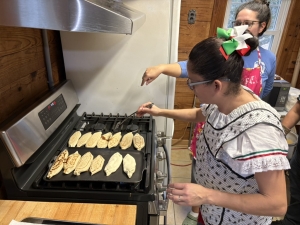
Latino cooking class with Ocracoke Alive. Photo courtesy of Ocracoke Alive.
“Over the past twenty years, the Latino community in Ocracoke has become an incredibly important part of the livelihood of the community here,” said Tweedie. “We simply couldn’t function in terms of having all the support workers and community members without this relatively new influx to our community. So in that respect, the Latino community is very embraced here by everyone. The different cultures on Ocracoke are very celebrated.”
Ocracoke Alive, with support from the Outer Banks Community Foundation, North Carolina Arts Council, and 21st Century grants, has facilitated arts activities for visitors as well as gatherings that enhance residents’ lives, including the Latino community on the island.
Their flagship summer event, the Ocrafolk Music and Storytelling Festival, is their largest and most established gathering, which attracts both locals and visitors alike, but they also host a multitude of others.
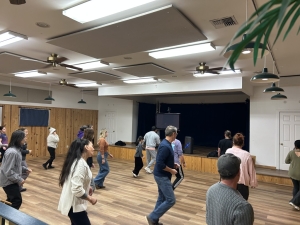
Latino dance class with Ocracoke Alive. Photo courtesy of Ocracoke Alive.
In November, they host the Festival Latino de Ocracoke, which celebrates Día de los Muertos (Day of the Dead) tradition. Throughout the off-season, Ocracoke Alive offers its “winter series” classes like Latin cardio dance taught in Spanish, unofficial ESL classes, library coffee hours, and more. They also facilitate weekly summertime live music and play productions at the Deepwater Theatre.
All of this is made possible by a community that values connection.
“We have about 207 artists that we engage with throughout the year in various activities as well as about 300 volunteers who have donated around 2,400 hours,” said Tweedie.
For an island of only 800-1,000 full-time residents, this kind of turnout is an incredible testament to the work of Ocracoke Alive.
Two volunteers, Drena Galarza and Sarah Shellow, share both a desire to help create connection in their island community as well as backgrounds in education and bridging cultural gaps.
Galarza, who moved to Ocracoke in 2022, became involved with Ocracoke Alive when David was organizing after-school enrichment programs. She helped host an after-school program where K-12 children played different games in Spanish once a week. Both Spanish-speaking and non-Spanish-speaking kids attended this program, which was created as a fun and accessible way for kids to learn other languages. Galarza also volunteered to help Ocracoke Alive facilitate a coffee hour at the local library.
“We are mindful that the Latino community should be comfortable having access to the public resources the library has,” said Galarza, when explaining that the intention for the coffee hour was language and cultural exchange in breakout groups of all ages, half in English and Spanish.
“There was also a desire for an ESL class, so since Sarah and I came from an education background, we thought we could pull something together,” said Galarza.
Anywhere from 5-12 people attended their weekly class throughout the off-season. The ESL class was held at both the Ocracoke Community Library as well as the Ocracoke School Library.
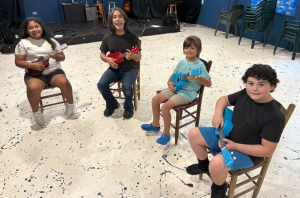
Ukelele lessons with Berkley School of Music graduate and Ocracoke resident Lou Castro. Photo courtesy of Ocracoke Alive.
“Ocracoke Alive has created opportunities for people who don’t normally run in the same circles to spend time with each other,” said Galarza. “As a child of an immigrant, I know a lot of spaces don’t necessarily feel like they’re for you, and the climate of our country makes some spaces feel intimidating and maybe not safe. So the more programming we host, the more people feel they can trust in their community.”
Shellow, another Ocracoke Alive volunteer, worked alongside Galarza to facilitate the coffee hour, and she has also taught yoga classes in Spanish.
“I learned to teach yoga in Spanish while living in Cuba, and there’s a specific vocabulary around yoga in Spanish that isn’t used in everyday language,” Shellow explained.
Shellow’s specialized vocabulary served as a way to offer a service to Spanish speakers in Ocracoke during their winter programming who would otherwise not have access to it.
Shellow has also served as a translator for a couple of presentations done by Mexican community members where they shared important cultural events, celebrations, and foods with the non-Latino community. These types of exchanges help “Make friends out of people who would otherwise have only been acquaintances,” Shellow explained.
Ocracoke Alive’s grants from the Outer Banks Community Foundation have helped facilitate all of the countless ways their multicultural programs bring the Latino and non-Latino community together.
“A lovely thing about living here is the diversity,” said Tweedie. “And, I think it’s really valuable for the kids growing up here to be able to experience that diversity of world culture. And because we are so isolated, to have a little bit wider worldview and to become friends and have great relationships with folks from different backgrounds is a wonderful thing.”
The Outer Banks Community Foundation’s next grant application deadline is Friday, October 30 for Impact Grants, which are open to all types of projects with no restrictions on scope or focus, with funding requests exceeding $10,000. Nonprofits are encouraged to visit the Community Foundation’s website for detailed guidelines, eligibility criteria, and the application portal. Early submissions are encouraged to allow time for review and feedback.
For more information or assistance with the grant application process, visit OBCF.org/grants or contact the staff at 252-423-3003.
About the Outer Banks Community Foundation: The Outer Banks Community Foundation is a 501(c)3 nonprofit organization committed to fostering philanthropy and supporting local causes. Through its charitable funds and grant programs, the Foundation strives to enrich the quality of life for residents of the Outer Banks.