The Last Founder: Jack Adams and the Story of the Outer Banks Community Foundation
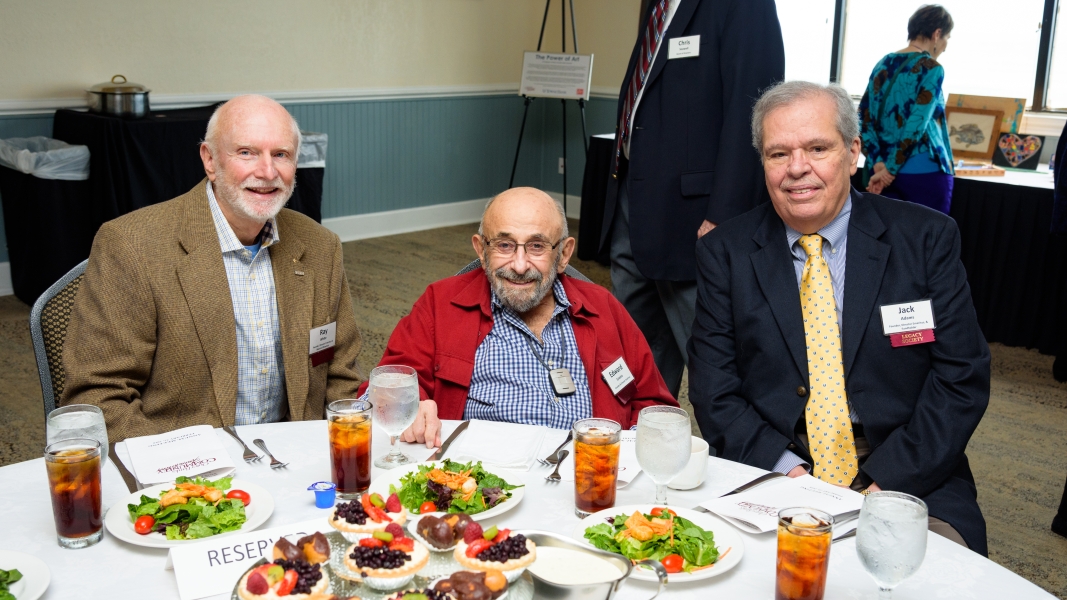
L-R- OBCF Founding Board Members Ray White, Edward Greene and Jack Adams at a community event. Photo courtesy of OBCF.
By Brian Tress
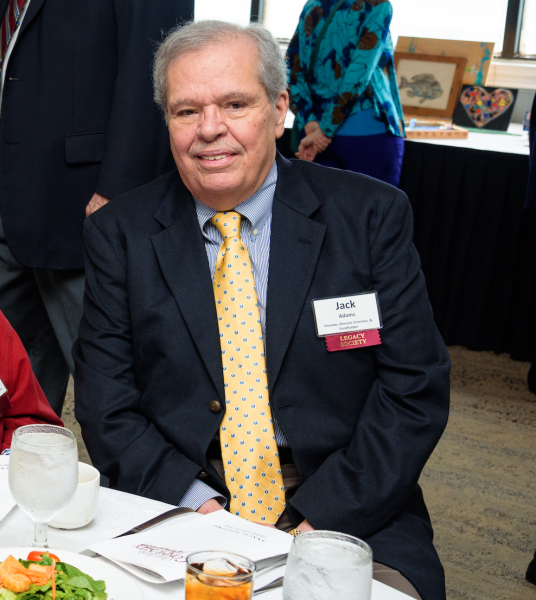
Jack Adams is 79, the sole surviving founder of the Outer Banks Community Foundation (OBCF), and still keeps a working life in Savannah, Tennessee. Most mornings find him at his desk, looking after the finances of a handful of charitable trusts. By early afternoon he’s home — the treadmill first, then a comfortable chair and a book until evening settles in.
He’s spent much of that life accounting for other people’s good causes — of the 25-plus organizations in North Carolina and Tennessee he did accounting work for, more than half were nonprofits. He was dedicated to his clients and keeping their books on track, even if that meant working 80 to 100 hours a week during tax season.
His Dare County work alone — chairing the board of Centura Bank, serving as treasurer of the Roanoke Island Historical Association and the Dare County Red Cross, and holding every office in the Dare County Jaycees before becoming its president — earned him the county’s Distinguished Service Award in 1991. But none of it meant as much to him as the organization he helped build from the ground up: the Outer Banks Community Foundation.
* * *
Adams was born in Philadelphia, though he has no real memory of the city — his family left when he was two or three. What followed was a childhood spent moving between relatives: a year with his grandparents, then years in Chesapeake, Virginia, with an aunt he says was as close as family gets. He worked from an early age, taking on construction jobs, digging ditches, and pulling two summers on a tugboat at a local shipyard — the overtime pay from those summers covered his first two years of college. He graduated from Great Bridge High School in 1965, one of a thousand seniors in his class.
Adams split his college years between Chowan College, a small Baptist school in Murfreesboro, North Carolina, and East Carolina University in Greenville, where he majored in business with a focus on accounting. He skipped fraternity life at ECU to save money and focus on his studies. It was at Chowan where he met his future wife, Linda, and they married in 1969.
His first job out of college set the direction for the career that followed. He went to work for a CPA in Elizabeth City, who told him plainly that growing a client base meant getting involved in the community, not just balancing his clients’ books. Three years later, in 1974, at 27, that same firm sent Adams to open a new office on the Outer Banks and made him partner. When his partner in Elizabeth City suffered a string of heart attacks, Adams ran both offices; not long after, he bought the Outer Banks practice outright.
Jack and Linda settled first in Kill Devil Hills, where they raised two daughters, Allison and Nicole, before divorcing. Both daughters still live on the Outer Banks today. His son from a later marriage, Jack, now lives in Chesapeake. Adams later bought a condo in Kitty Hawk where “he could see the sound out of the kitchen window and the ocean from the living room,” and eventually a house in Southern Shores.
By the time David Stick called him in the spring of 1982, the Outer Banks had already started to change. Stick was a partner in the Kitty Hawk Land Company — which had implemented the master plan for the town of Southern Shores — and was now pursuing new residential development north from Duck toward Corolla, and the Outer Banks’ first chain restaurants and motels had begun opening. “People found out about the place,” Adams said.
Stick needed to know how to start a charitable foundation legally, and Adams, who was the accountant for the Kitty Hawk Land Company, walked him through it — file for tax-exempt status with the IRS, then the group could start using the name Outer Banks Community Foundation. Adams recounts, “David Stick came to me and he told me he had talked with Andy Griffith and George Crocker about the idea of doing a foundation and he wanted me to tell him what he needed to do to start a charitable foundation. I would be the CPA, Ray White would handle the bank, and Martin Kellogg, who joined the board later that year, would be the attorney. Eddy Green, David and Andy would provide the seed funding.”
“Andy actually came to some of the board meetings – he was like anybody else,” he added.
Stick assembled the board of directors with intention, remembered Cashar Evans, who owned a restaurant in Kill Devil Hills at the time and would later become an OBCF board member and one of Adams’s close friends. “This was his baby,” Evans said.
Under Stick as president, the board met for the first time on November 16, 1982, and that same month, the founders introduced the idea to the public at a community meeting in Manteo. About a hundred people showed up, each one, as Adams remembers it, “asking us, are you gonna help so-and-so?”
In OBCF’s early years, Cashar Evans remembers the board moving its money from bank to bank chasing the best CD rates, making small grants for start-up costs and equipment, and often helping applicants write their own requests.
Adams served as OBCF’s treasurer under Stick in the founding years, then later took over as president himself for what he estimates was four or five years, all while his accounting practice kept growing.
The Foundation’s first grants, in 1983, went to the Outer Banks Hotline and Friends of Nags Head Woods. Adams recalls scholarship funds following soon after, along with support for the arts and animal welfare.
“We had forms that people filled out about what they needed and we would review them to see if we could help or not,” Adams said. “At that point in time, we’d look at the form — we asked for financial statements to see if they actually needed money or not and what they were doing with their money. Based on that and what we knew about the applicant, we made the determination on funding. I can’t think of any people at that point in time who we turned down. Our duty was to help people and organizations in need and at that time, and we knew everyone anyhow so it was easy to vet them and trust them.”
By the early 1990s, increasing visitation to the Outer Banks and a lengthening tourist season crowded out what he loved most about the place — the quiet months filled with fishing, golf, friends, and his nonprofit work. He sold his practice in the early 1990s and, for a while, split time between the Outer Banks and a house in Cancún before relocating full-time to Diamond City, Arkansas, on the shores of Bull Shoals Lake.
In Arkansas, Adams took a job as CFO for a leather goods manufacturer supplying retailers like Barneys and Saks. It ended after five years, when the company’s owners wanted him to help set up trusts to hide assets from the IRS. Adams refused, later cooperating fully with federal investigators and testifying before a grand jury.
While in Arkansas, he met Susan Brown, who would become his wife. In 1999, the couple moved to her hometown of Savannah, Tennessee, to care for her ailing mother, and Adams opened a new solo CPA practice there in January 2000 — the same year they married.
In Savannah, a familiar pattern emerged: Adams took on major roles with several civic and charitable organizations, including finance chair at First United Methodist Church, treasurer of the Savannah Rotary Club, director of the Hardin County Chamber of Commerce, and charter president of the Hardin County Community and Healthcare Foundation.
In 2016, he fell down a flight of stairs and broke his hip. The recovery was long and difficult — months in a hospital and nursing home, mini-strokes, anemia, more than a year before he could walk again — forcing him to sell his Savannah practice. He quit drinking during that stretch, and says he grew closer to his faith. “I was in a position to do that because I couldn’t help myself,” he said. “He was the one to go to.”
Susan passed in 2018. Between his three children — Allison, Nicole and Jason — Adams has four grandchildren, ranging in age from 12 to 25.
“Jack was part of a group of leaders with the vision to imagine what a community foundation could mean for the Outer Banks,” said OBCF President & CEO Chris Sawin. “More than four decades later, everything we do at OBCF builds on what they started. Jack’s commitment to the Outer Banks is a legacy we are proud to carry forward.”
Looking back across his career — the Outer Banks, Arkansas, Tennessee — Adams doesn’t hesitate when asked what mattered most. “I’m proudest of the OBCF,” he said. “They did the most good for the community — they met the needs that were not being met. And they were great people to work with, too.”
About the Outer Banks Community Foundation: The Outer Banks Community Foundation is a 501(c)3 nonprofit organization committed to fostering philanthropy and supporting local causes. Through its charitable funds and grant programs, the Foundation strives to enrich the quality of life for residents of the Outer Banks.